
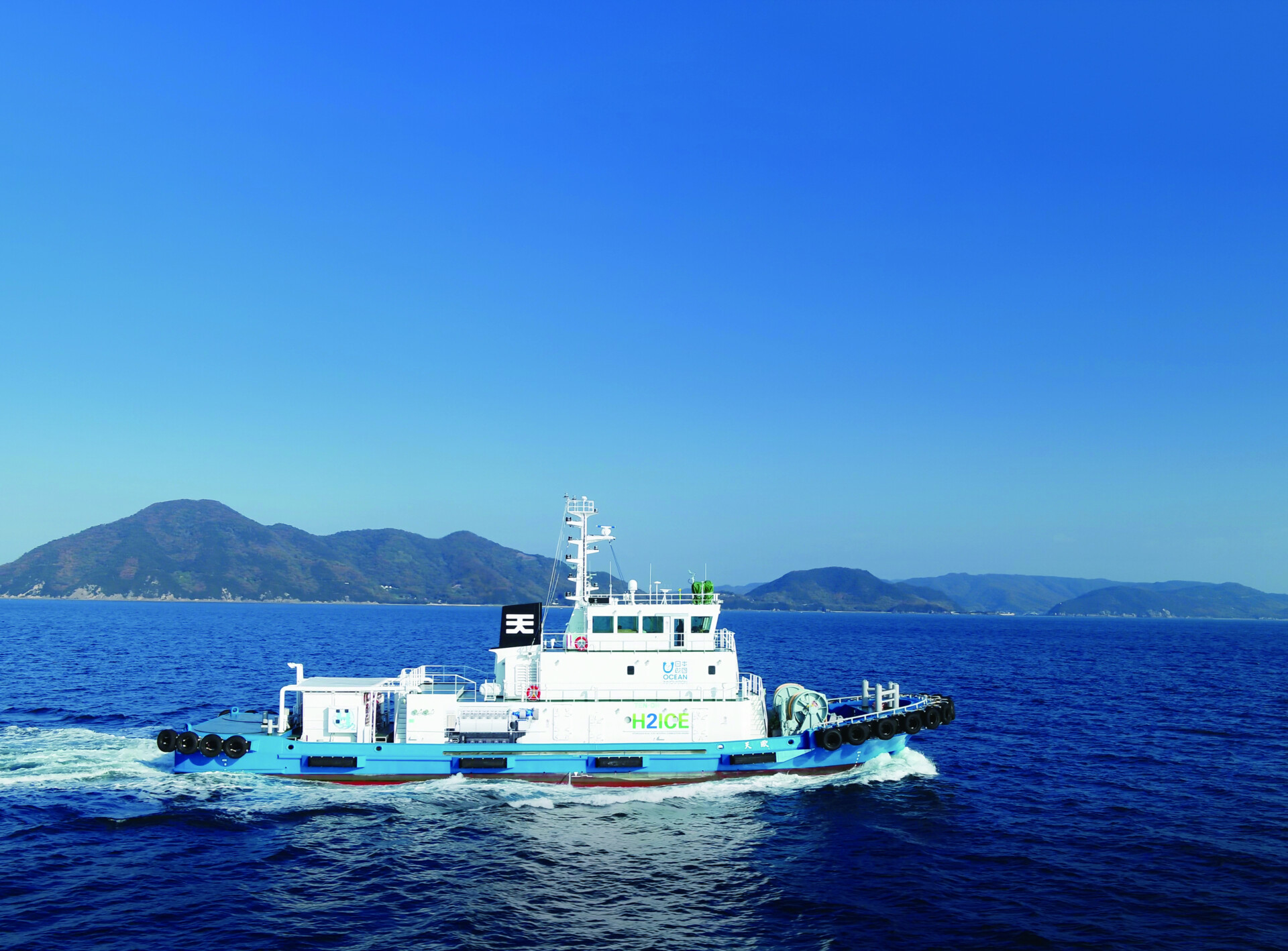
Last week marked an important milestone in the decarbonisation of maritime operations: the successful delivery of Ten-Oh, Japan’s first tugboat powered by BeHydro dual fuel hydrogen engines. Built by TSUNEISHI SHIPBUILDING Co., Ltd., Ten-Oh represents a major step forward in demonstrating the readiness of hydrogen technology for real-world marine applications.
At the heart of the vessel are two BeHydro V12 dual fuel hydrogen engines, each delivering 1,618 kW at 968 rpm. These high‑performance engines offer the same operational capability as conventional marine propulsion while enabling significant CO₂ reductions, proving that hydrogen can power demanding working vessels without compromise.
The tugboat forms part of The Nippon Foundation’s Zero Emission Ships Project, an ambitious programme aimed at accelerating the development of vessels with drastically reduced or zero carbon emissions. Equipped with high-pressure hydrogen storage tanks, Ten-Oh can operate using hydrogen-blended fuel and seamlessly switch to marine fuel if required, ensuring the same high safety standards as traditional vessels.
The delivery of Ten-Oh is also a milestone for JPNH2YDRO, which supplied the fuel systems and hydrogen technologies that make this vessel possible.
At BeHydro, we are proud to see our engines driving tangible progress toward maritime decarbonisation. The Ten-Oh is proof that hydrogen is ready for deployment today, not just as a future concept but as a practical, reliable and scalable solution for heavy-duty marine applications.
As more shipowners and operators look for clean, high-performance propulsion options, BeHydro will continue to support the transition toward a greener maritime industry, one vessel at a time.
